There glossary of terms and the table of properties of components are the most undervalued tables in Wardley maps.
Glossary of terms
This table is essential to know how to read a Wardley Map, without it, you cannot read medium or complex maps. Before to draw a map, you should cultivate the ability to read maps and make questions from the map that make you gain better understanding of a given scenario.
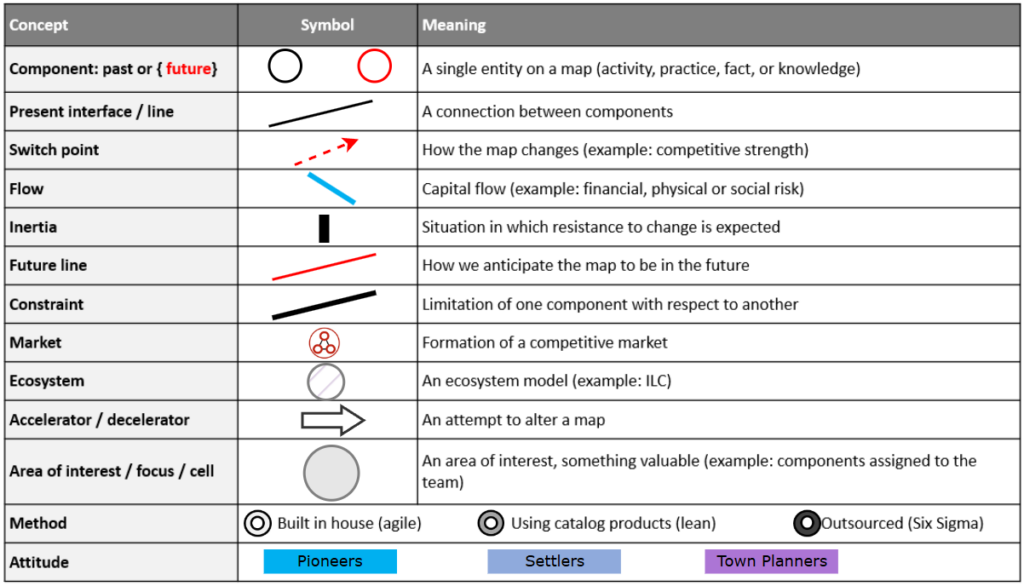
Table of properties of components
For a given component, practice, data or knowledge, you should be able to identify in what stage of evolution it is. The table of properties provides you that deck for the conversation.

By identifying where a component falls in terms of these properties, you can:
- Map its Evolutionary Stage: Recognize if it’s an innovation, custom-built solution, product, or commodity.
- Strategic DEcisions: Determine if you should focus on innovation, continuous improvement, or operational efficiency.
- Market Actions: Tailor your approach—whether to experiment and tolerate failure or optimize and standardize.
In short, this table acts as a framework to assess and position components on a Wardley Map, guiding strategic decisions based on their stage of evolution.
This diagram below shows in a visual way how the table of properties works:
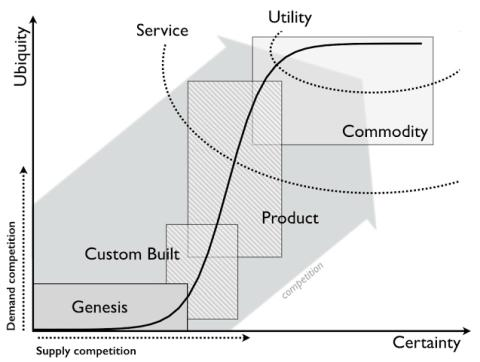
If you position the components in a map in the wrong place the decisions you are making are going to be wrong.
Takeaways
Learn to walk before you run.
In the short time, it will take time to learn (yes, Wardley maps learning curve is slow), but in the long run, you will run faster and with probabilities that you are running in the right direction.
 WordPress
 Google +
  Facebook