NVIDIA Ising is a specialized family of open AI models built to solve the two biggest operational headaches in quantum computing: keeping quantum computers tuned and fixing their constant errors in real time.
Quantum computers don’t use standard chips; they rely on fragile quantum bits (qubits) that get thrown off by tiny changes in temperature, electromagnetic noise, or ambient vibration. Think of NVIDIA Ising as an intelligent, automated pilot sitting inside the classical control system managing the quantum processor.
Ising focuses on two primary functions:
- Automating Calibration (Ising Calibration): Quantum processors require constant tuning, a process that traditionally took human engineers hours or even days of trial-and-error measurement. Ising acts as an AI agent that analyzes visual diagnostic data from the machine, automatically adjusting physical parameters to shrink tuning down to a matter of hours.
- Fixing Real-Time Errors (Ising Decoding): Qubits break down and lose data rapidly. To compensate, system architects bundle hundreds of noisy physical qubits together to act as a single, error-free “logical qubit.” Ising uses deep learning algorithms running on NVIDIA GPUs to analyze sensor outputs, identify exactly where a bit flipped or glitched, and calculate corrections in real time.
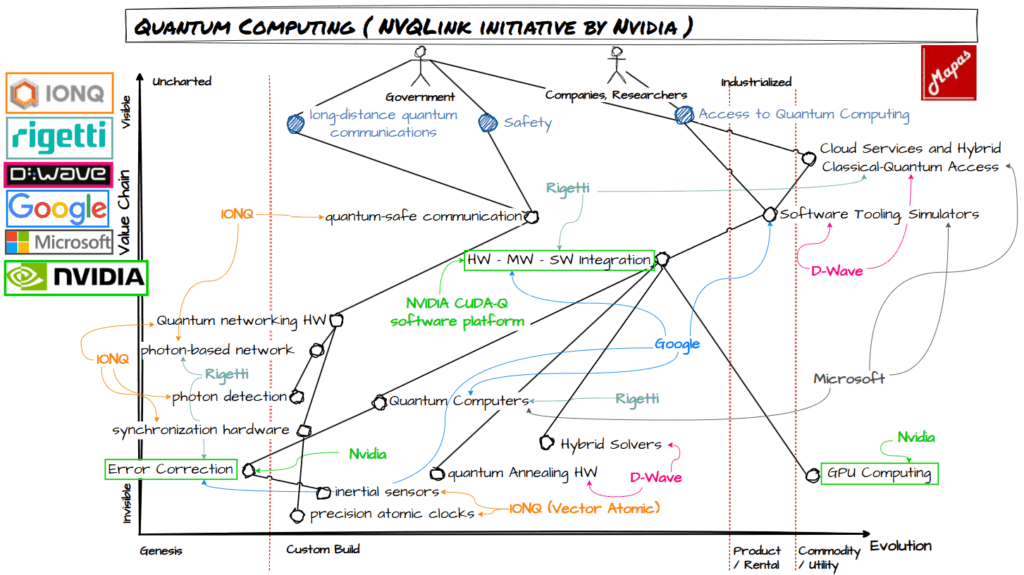
NVIDIA Ising depends on CUDA-Q and NVQLink components:
- CUDA-Q (Software Layer): Direct, critical dependency. Ising is a set of AI models, and its decoding and training frameworks are built natively on PyTorch and the CUDA-Q / CUDA-QX platform. CUDA-Q serves as the software runtime where Ising runs to process quantum error correction and calibration.
- NVQLink (Hardware Interconnect Layer): Operational pipeline dependency. NVQLink provides the physical, sub-microsecond hardware link connecting the QPU to the GPU.
 WordPress
 Google +
  Facebook