Quantum annealing is a quantum computing technique used to solve optimization problems by finding the lowest-energy state of a system.
It works by encoding a problem into a mathematical energy landscape, where the best solution corresponds to the global minimum. The quantum computer then starts in a simple, easily prepared ground state and gradually evolves (or “anneals”) toward the complex problem Hamiltonian. Quantum effects like superposition and tunneling help the system escape local minima and increase the chance of reaching the global minimum.
What problems does quantum annealing try to solve?
Quantum annealing is mainly designed for optimization problems—situations where you need to find the “best” solution out of many possible ones, especially when the search space is huge and complex. Here’s a list of problem types it targets:
- Combinatorial Optimization Problems: example, Vehicle routing and logistics optimization
- Graph-related Problems, example: Max-Cut (partitioning a graph into two sets)
- Constraint Satisfaction Problems, example: Sudoku-like puzzles.
- Machine Learning Optimization, example: training restricted Boltzmann machines (RBMs)
- Financial Optimization, example: Portfolio optimization (balancing risk vs return).
- Materials Science & Physics, example: Protein folding approximations
- Telecom & Networks, example: Traffic flow optimization.
Is HW or SW?
Quantum annealing is fundamentally a hardware capability, but it requires specialized software to make it usable.
- Hardware → Quantum annealers (e.g., D-Wave machines) are physical quantum devices that implement the annealing process. They realize the quantum Hamiltonian evolution, tunneling, and ground state search in actual quantum hardware.
- Software → To use quantum annealing, problems must be translated (mapped) into QUBO or Ising models. This requires software toolchains, compilers, and hybrid solvers (which often combine classical pre/post-processing with the quantum hardware).
So:
- Core capability = hardware (quantum physics happening in the device).
- Practical use (practice) = hardware + software integration.
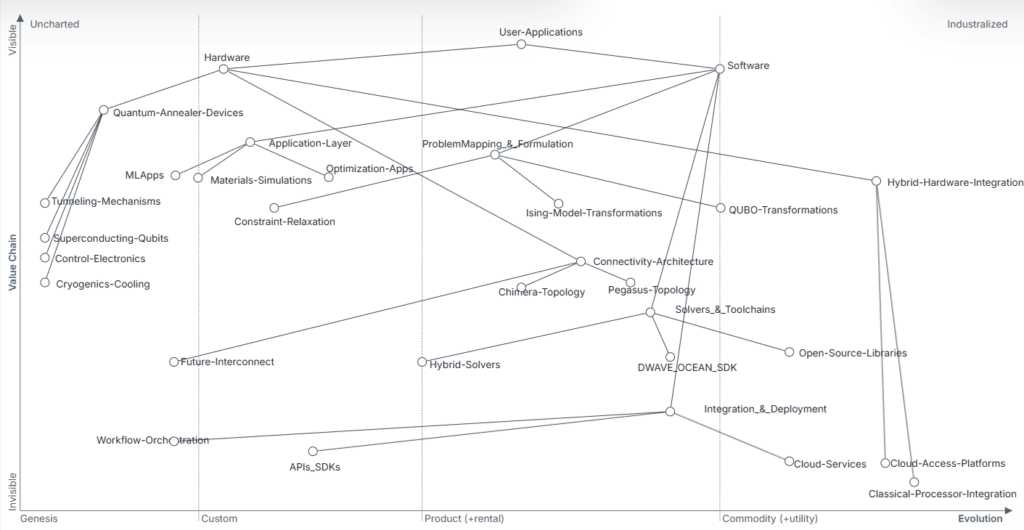
A Tree of capabilities could be
Quantum Annealing
├── Hardware
│ ├── Quantum Annealer Devices
│ │ ├── Superconducting qubits (Genesis/Custom Build)
│ │ ├── Cryogenics & cooling systems (Custom Build/Product)
│ │ ├── Control electronics & flux biasing (Custom Build/Product)
│ │ └── Quantum tunneling mechanisms (Genesis/Custom Build)
│ ├── Connectivity Architecture
│ │ ├── Chimera topology (Product)
│ │ ├── Pegasus topology (Product)
│ │ └── Future interconnect designs (Genesis/Custom Build)
│ └── Hybrid Hardware Integration
│ ├── Classical processors (Commodity)
│ └── Cloud access platforms (Product/Commodity)
│
└── Software
├── Problem Mapping & Formulation
│ ├── QUBO transformations (Product/Commodity)
│ ├── Ising model transformations (Product)
│ └── Constraint relaxation techniques (Custom Build)
├── Solvers & Toolchains
│ ├── D-Wave Ocean SDK (Product)
│ ├── Hybrid solvers (Custom Build/Product)
│ └── Open-source libraries (e.g., qbsolv, dwave-hybrid) (Product/Commodity)
├── Application Layer
│ ├── Optimization (routing, scheduling, finance) (Custom Build)
│ ├── Machine learning (clustering, RBMs) (Custom Build/Experiment)
│ └── Materials & physics simulations (Experiment/Custom Build)
└── Integration & Deployment
├── APIs & SDKs (Python, C++, etc.) (Product/Commodity)
├── Cloud services (Leap by D-Wave, AWS Braket, Azure Quantum) (Product)
└── Workflow orchestration (embedding quantum into enterprise apps) (Custom Build/Experiment)
A map using the tree,
 WordPress
 Google +
  Facebook