This week IONQ and Google did a couple of announcements.
- IonQ Achieves Landmark Result, Setting New World Record in Quantum Computing Performance.
- Our Quantum Echoes algorithm is a big step toward real-world applications for quantum computing.
The achievements are necessary and small steps in the long run of this race, and they done in different spaces.
In plain english: IONQ has improved their error control and Google has been able to run quantum models in a physical computer.
Using the Wardley map, the spaces where the achievement is done is different.
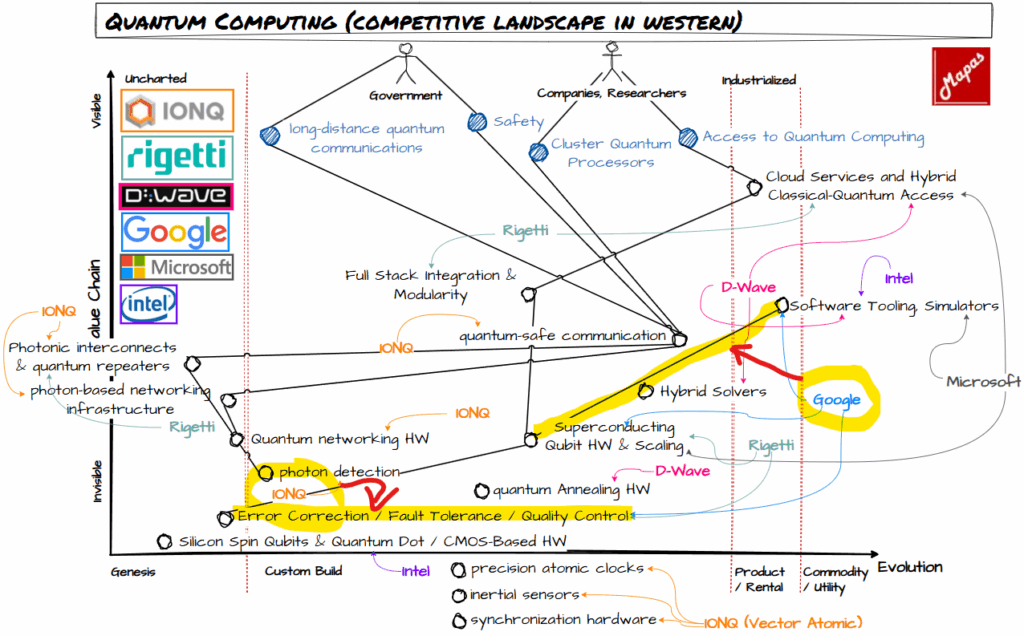
Both companies are playing the game in different spaces, and their technologies and the problems they are trying to solve are different too.
The main differences between Google’s Willow chip technology and IONQ’s technology stem from the fundamental type of qubit they use. Let’s see some fundamental ones.
| Feature | Google Willow Chip Technology | IONQ Technology |
| Qubit Type | Superconducting Qubits (specifically Transmons) | Trapped Ions (individual charged atoms) |
| Operating Environment | Requires extreme cryogenic cooling (near absolute zero, (± 20 mK) using complex dilution refrigerators. | Operates at less extreme temperatures (closer to room temperature) in an ultra-high vacuum chamber, controlled by lasers and electric fields. |
| Qubit Control | Controlled using microwave pulses sent through control lines on the chip. | Controlled using precisely tuned laser pulses and electric fields to manipulate the ion’s quantum state. |
| Qubit Connectivity | Limited (Nearest-Neighbor): Qubits typically only interact with their immediate physical neighbors, which can increase the number of operations (and thus errors) required for complex algorithms. | Fully Connected (All-to-All): Any qubit can interact with any other qubit in the trap directly, which simplifies algorithms and reduces the number of gates required. |
| Error/Fidelity | Historically challenged by shorter coherence times and high sensitivity to noise, but Google’s latest breakthrough focuses on achieving scalable error correction (“verifiable quantum advantage”). | Known for very high fidelity (low error rates) and long coherence times, recently achieving a world record of $99.99% two-qubit gate performance. |
| Scalability | High Integration Potential: Fabricated using semiconductor techniques, which makes them theoretically easier to scale to very large numbers (± 1,000 qubits) on a single chip. | Scaling Challenge: Scaling up the number of ions in a single trap while maintaining high control and fidelity is a significant technical challenge, though IONQ is working on modular connections. |
| Focus/Approach | Heavily focused on scientific breakthroughs, such as demonstrating quantum advantage and leading-edge error correction, backed by a massive research effort. | Highly focused on commercial viability and hardware performance as a service (QCaaS), making their systems available via all major cloud platforms. |
 WordPress
 Google +
  Facebook