NVIDIA CEO Jensen Huang announced NVQLink, a new open system architecture designed to connect their powerful GPU supercomputers with quantum processors (QPUs).
This hybrid computing approach aims to:
- Accelerate quantum error correction and control using the classical GPUs.
- Scale up quantum systems from hundreds to potentially hundreds of thousands of qubits in the future.
- Unite quantum and classical computing into a single, coherent system, which Huang called the “Rosetta Stone” between the two.
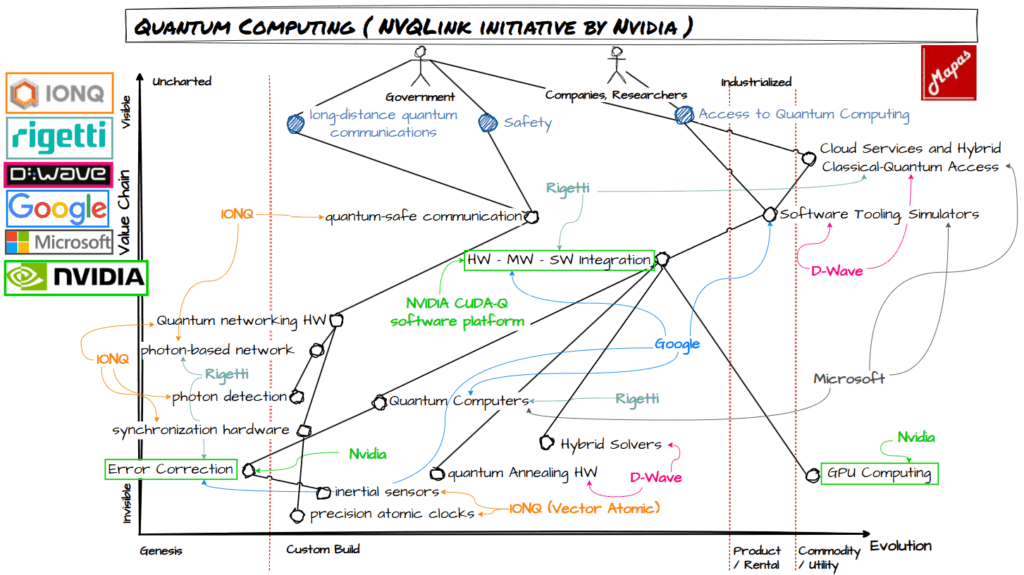
I have used the basis of the previous map, but I have taken the opportunity to do a revision and reorganizing components. NVQLink plays the game here, especially on the software-middleware layer with the Quda-Q software platform (what is called the “Rosetta Stone”):
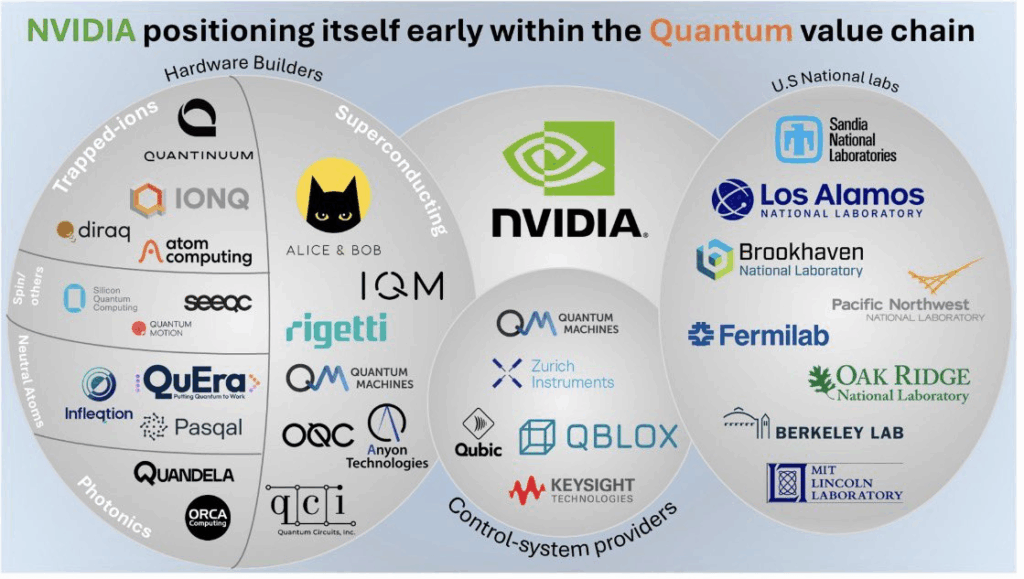
The initiative already has the support of 19 quantum builders and nine U.S. national laboratories.
The 17 companies are:
- Alice & Bob (private)
- Anyon Computing (private)
- Atom Computing (private)
- Diraq (private)
- Infleqtion (private)
- IonQ (public NYSE)
- IQM Quantum Computers (private)
- ORCA Computing (private)
- Oxford Quantum Circuits (private)
- Pasqal (private)
- Quandela (private)
- Quantinuum (private, majority-owned subsidiary of Honeywell)
- Quantum Circuits, Inc. (private)
- Quantum Machines (private)
- Quantum Motion (private)
- QuEra (private)
- Rigetti (NASDAQ)
- SEEQC (private)
- Silicon Quantum Computing (private)
You can see how D-Wave (which I mentioned before) is not in the list. It looks like Annealing models and technology is not interesting for this initiative.
The list of laboratories is:
- Brookhaven National Laboratory
- Fermi National Accelerator Laboratory (Fermilab)
- Lawrence Berkeley National Laboratory (Berkeley Lab)
- Los Alamos National Laboratory
- MIT Lincoln Laboratory
- Oak Ridge National Laboratory
- Pacific Northwest National Laboratory
- Sandia National Laboratories
- Argonne National Laboratory
Takeaways
Nvidia has positioned themselves in the middle of the map They were able to orchestrate HW and SW in GPUs better than anybody else, and now they are orchestrating the connection between GPUs and QC, who will build the other side? they don’t care.
Quantum computing timeline is expected for 10-20y in some of the capabilities. The fact that Nvidia is bridging both worlds (classing computing with quantum), they’re accelerating the adoption and attracting capital to shorter years of investments. This is not trivial, as capital expects ROI and prefer shorter cycles of ROI and risk reduction.
This approach also enables Nvidia to learn the use cases that really matters. Right now there are many use cases in experimentation, not validated. To be in the middle of the picture enable them to anticipate to what is coming.
 WordPress
 Google +
  Facebook