In January Nvidia announced the Rubin Platform.
It provides many things in terms of data center but my interest is in the link between this new architecture of capabilities and NVQLink announced last November 2025.
The problem of Quantum Computers
The biggest hurdle in quantum computing is that qubits are unstable and prone to errors. Fixing these errors requires massive, near-instant classical calculations.
Most classical computers are too slow to fix quantum errors before the quantum state collapses, and here is where Nvidia foresees the opportunity: provide that Quantum Error Correction “power” to Quantum computers.
How? With the Rubin Platform, an evolution of Blackwell architecture.
What are the main capabilities of the Rubin Platform?
Rubin platform is a hardware powerhouse, a combination of these main capabilities.
- Rubin GPU: HBM4 memory and delivering 50 petaflops of AI inference performance (a 5x jump over Blackwell architecture). Solve the math problem fast… before the qbit collapses!
- Vera CPU: A custom Arm-based processor with 88 “Olympus” cores, specifically built to handle the logic and orchestration required for AI agents.
- NVLink 6 Switch: Provides 3.6 TB/s of bandwidth per GPU (run, run… before the qbit collapses!).
- ConnectX-9 SuperNIC: Handles the “scale-out” networking to connect multiple racks.
- BlueField-4 DPU: Offloads security, storage, and networking tasks so the GPU and CPU can focus entirely on AI reasoning.
- Spectrum-6 Ethernet Switch: AI-native Ethernet switch with co-packaged optics for extreme power efficiency.
How are the Rubin platform and NVQLink related?
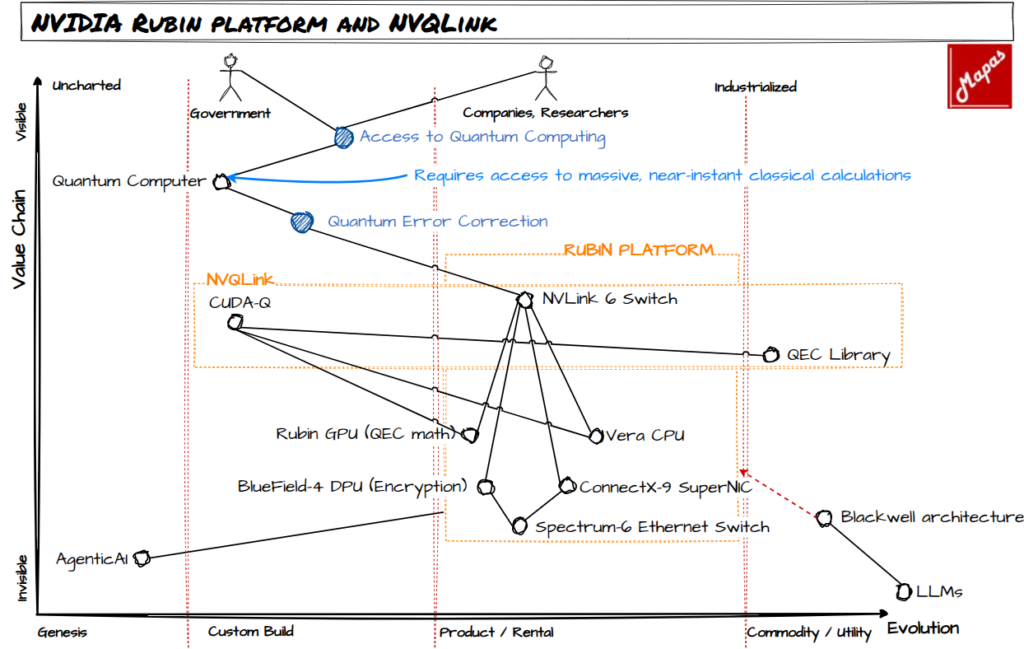
The Rubin platform provides the massive computational muscle for AI and scientific research, NVQLink is the dedicated communication highway that allows that muscle to be used by quantum computers.
Trying to go down in detail, the main components of NVQLink are:
- NVLink 6 Switch: you already know this one.
- CUDA-Q: Open Source software that provides an unified programming language for CPU, GPU, and QPU.
- QEC Library: Pre-built “decoders” for fixing quantum errors instantly.
The link between the two can be simplified as follows:
| Rubin Component | Relationship to NVQLink | Role |
| ConnectX-9 SuperNIC | Physical Interface | The “Port” where the NVQLink cable actually connects. |
| Vera CPU | Orchestrator | Manages the CUDA-Q software and the “callbacks” to the QPU. |
| Rubin GPU | Processor | Performs the real-time math (like Error Correction) for the QPU. |
| NVLink 6 Switch | Internal Fabric | Distributes incoming NVQLink data across all GPUs in the rack. |
| BlueField-4 DPU | Security/Infrastructure | Encrypts the NVQLink data stream via Confidential Computing. |
A Wardley Map to visualize all these dependencies
Takeaways
In November NVIDIA announced NVQLink, as a long term vision environment to connect two words: classic computing (CPU and GPU) and QPU.
Now in January they have announced Rubin Platform, a concrete solution for the main Quantum problem: QEC.
What will happen? I have no clue. Some questions that come to my mind.
Who is already working with NVQLink?
- Some US, German and APAC Laboratories
- Quantinuum: Recently used NVQLink with their Helios QPU to demonstrate the world’s first scalable real-time decoding for quantum error correction.
- IonQ: Currently using NVQLink and CUDA-Q to integrate their trapped-ion systems with enterprise-grade NVIDIA infrastructure.
- IQM Quantum Computers: Integrating NVQLink into their “IQM Constellation” platform for superconducting qubits.
- Rigetti Computing: Utilizing the link to scale their multi-chip quantum processors.
- Other Notable Partners: QuEra (Neutral Atoms), Pasqal, Alice & Bob, Atom Computing, Oxford Quantum Circuits (OQC), and SEEQC.
Who will be the first relevant players adopting the Rubin Platform?
 WordPress
 Google +
  Facebook