Microsoft’s Majorana and Google’s Willow seem to be completely different things.
Both companies presented updates of their projects by 2025, where the product they introduce on the stage is a processor.
They represent two fundamentally different philosophies. While Google is perfecting a high-performance engine that is already running, Microsoft is building an entirely new type of propulsion system from scratch and that has no dependency of Cooling refrigerators.
Primary Achievement (2025)
- Google Willow: Demonstrated Quantum Advantage by performing a Random Circuit Sampling (RCS) task in 5 minutes that would take a supercomputer septillions of years.
- Microsoft Majorana 1: Demonstrated a New State of Matter. It proved that Majorana quasiparticles can be created and controlled on a chip, validating a decades-old theory.
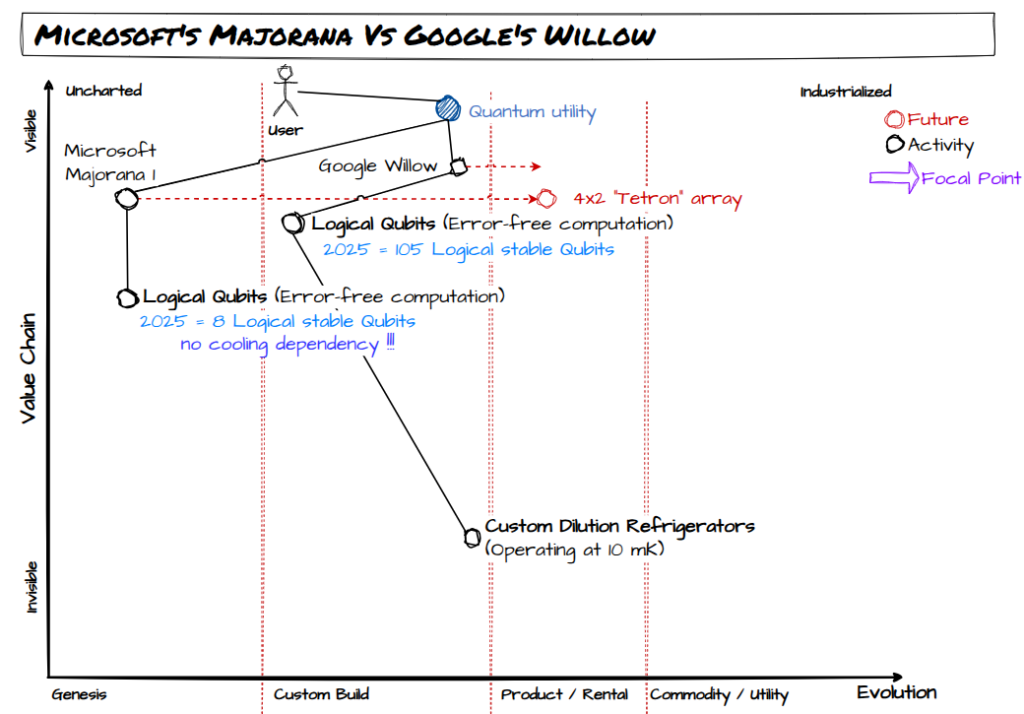
A Wardley Map
My understanding of the main capabilities being build by both companies.
Quick Comparison Table
| Feature | Google Willow | Microsoft Majorana 1 |
| Technology | Superconducting | Topological |
| Current Logical Qubits | 105 | 8 |
| Maturity | High (Proven Advantage) | Emerging (Scientific Breakthrough) |
| Scaling Potential | Iterative (Thousands) | Exponential (Millions) |
| Control Signal | Analog | Digital |
| Stability | Fragile (needs active fixes) | Robust (naturally shielded) |
Strategic Movement (The “Play”)
- Microsoft is playing in the Genesis space to create a “New Utility” that can scale vertically without the massive footprint of traditional quantum fridges.
- Google is executing an Efficiency Play. They are taking a known but “noisy” technology (Superconducting) and using sheer engineering excellence to force the noise down.
Focal points
- Microsoft’s focal point is improve their ability to shape “Materials” (as they need Hardware Protected stability). This is a major challenge I detail more below.
- Google’s focal point is reduce the noise in the physical qubits, so that they can reach a million qubits through iterative, massive-scale manufacturing of their current design.
Microsoft challenge looks wild
Five Material Capabilities they need to be revolutionized!
1. The “Topoconductor” Stack (Indium Arsenide + Aluminum)
Microsoft’s qubits aren’t made of circuits, but of a specialized “heterostructure.”
- The Component: A hybrid nanowire where a semiconductor (Indium Arsenide) is wrapped in a superconductor (Aluminum).
- The Materials Challenge: To host Majorana particles, the interface between these two materials must be atomically perfect. Any single misplaced atom or “disorder” at the boundary creates “Andreev Bound States”—fake signals that look like Majorana particles but offer zero error protection.
- The Revolution Needed: Moving from “lab-grown” precision to industrial-scale, defect-free fabrication of these hybrid nanowires.
2. The Topological Gap (The “Shield”)
- The Component: The Energy Gap between the qubit’s ground state and the surrounding noise.
- The Materials Challenge: Currently, the “topological gap” in Microsoft’s materials is quite small (fragile). If the gap is small, even tiny amounts of heat or magnetic interference can “jump” the shield and cause an error.
- The Revolution Needed: Discovery of new material combinations that create a larger topological gap, making the qubit much more rugged and less reliant on extreme cooling.
3. High-Quality “Tetron” Junctions (The H-Shape)
- The Component: The H-bridge (Tetron) where four Majorana modes meet to form one qubit.
- The Materials Challenge: At the junctions where the nanowires cross, the materials tend to lose their “topological” properties. This is why Microsoft’s current X-measurement fidelity is only ~84%—the signal gets “lost” or noisy at these physical intersections.
- The Revolution Needed: Improved epitaxial growth (growing the crystals in the exact shape of the circuit) to ensure the topological phase remains continuous across the entire H-structure.
4. Low-Noise Dielectrics (The 1/f Noise Problem)
- The Component: The insulating layers and substrates the chip sits on.
- The Materials Challenge: Recent 2025 research suggests that “1/f noise” (low-frequency background noise) from the semiconductor material itself might be killing the qubit’s “memory” faster than expected.
- The Revolution Needed: Developing ultra-purified semiconductor substrates that don’t “hum” with electronic noise, which would allow the Majorana particles to remain stable for seconds rather than milliseconds.
5. Cryogenic CMOS (The Digital Controller)
- The Component: On-chip digital switches that control the qubits at absolute zero.
- The Materials Challenge: Standard silicon transistors don’t work well at the ultra-cold temperatures required for quantum chips.
- The Revolution Needed: A materials-level redesign of CMOS (Complementary Metal-Oxide-Semiconductor) logic that can operate efficiently at 10 millikelvin without generating heat that would destroy the quantum state.
What can we read in the guidance?
Both companies still provide a 1 year guidance and add notes about what they are planning to do. Not concrete dates but some clear major actions.
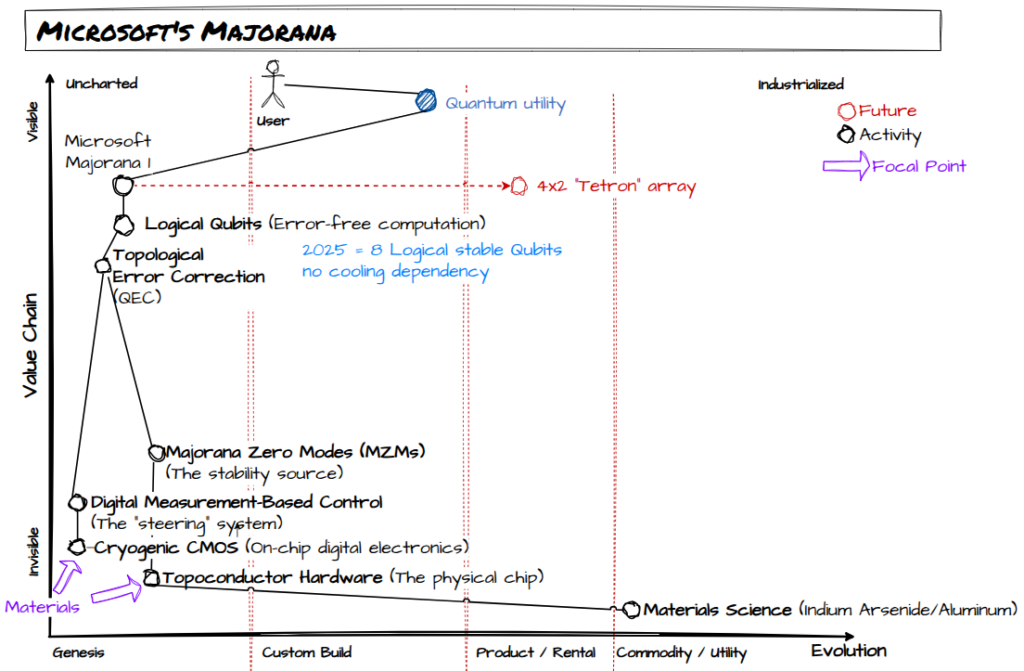
Microsoft’s guidance on Quantum
- Next Milestone (2026–2027): Moving from 8-qubit Majorana 1 chip to a 4×2 “Tetron” array. The goal is to demonstrate entanglement and “braiding” (the unique way topological qubits process logic) for the first time.
- The “Fault-Tolerant Prototype” (FTP): Under a DARPA agreement, Microsoft expects to build a full fault-tolerant prototype in the next few years (5, 10… who knows!). They are banking on their “4D geometric codes” to reduce the physical-to-logical qubit ratio by 1,000x.
- Commercial Integration: Microsoft is already integrating its quantum roadmap into its Quantum-Safe Program (QSP). They expect early adoption of “quantum-safe” capabilities by 2029, with a total infrastructure transition by 2033 (here they are more clear about dates).
- The “Million Qubit” Goal: This is their ultimate purpose on quantum, they maintain that their digital voltage control and small qubit size make a million-qubit chip—the size of a human palm—technically feasible within this decade (yes, that’s before 2030).
Represented within a Wardley Map:
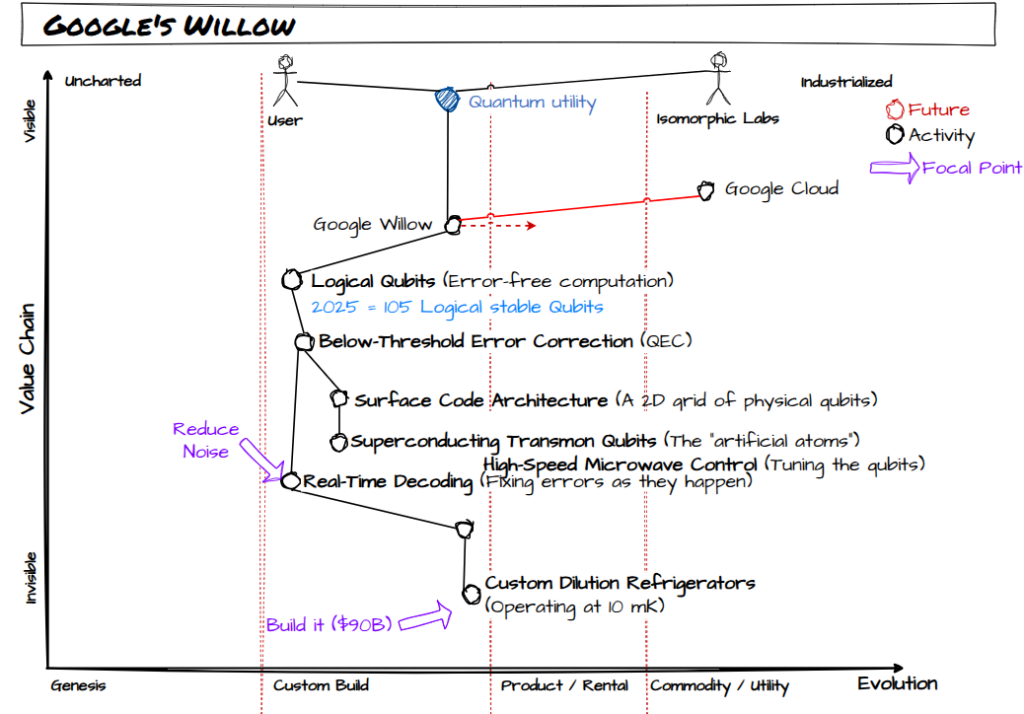
Alphabet’s guidance
- Near-Term Focus (2026): Use the Willow chip (105 qubits) to run “Quantum Echoes” algorithms. They are using it to model molecular interactions for drug discovery (via Isomorphic Labs).
- Milestone 3 (The “Long-Lived” Qubit): Google is currently working toward a logical qubit that can perform one million steps with fewer than one error. This requires scaling beyond the current 105-qubit array to thousands of physical qubits.
- Capital Expenditure (CapEx): Alphabet has signaled massive investment (part of a $90B+ annual CapEx plan) to build the custom dilution refrigerators and nanofabrication facilities needed to scale Willow’s architecture.
- Commercial Cloud: Alphabet’s 2026 guidance suggests that “Quantum Advantage” will become a unique selling point for Google Cloud, specifically to lower the costs of training large AI models (like Gemini) using quantum-assisted optimization.
Represented within a Wardley Map:
Takeaways
Many things coming from these two companies in this space. The do not disclosure any acquisition but it will not be surprised that something from that nature happens.
The different notes will serve me in the future to check what they really achieved.
 WordPress
 Google +
  Facebook