A Bitcoin treasury company is a firm that holds a significant portion of its corporate reserves or balance sheet assets in Bitcoin.
More specifically, the term often refers to publicly traded companies that:
- Allocate a large majority of their assets to Bitcoin as a primary strategy, often aiming to accumulate as much Bitcoin as possible.
- Raise capital (via stock offerings or debt) specifically to acquire more Bitcoin, effectively providing investors with indirect price exposure to the cryptocurrency through traditional equity markets.
Who are the main clients of these companies?
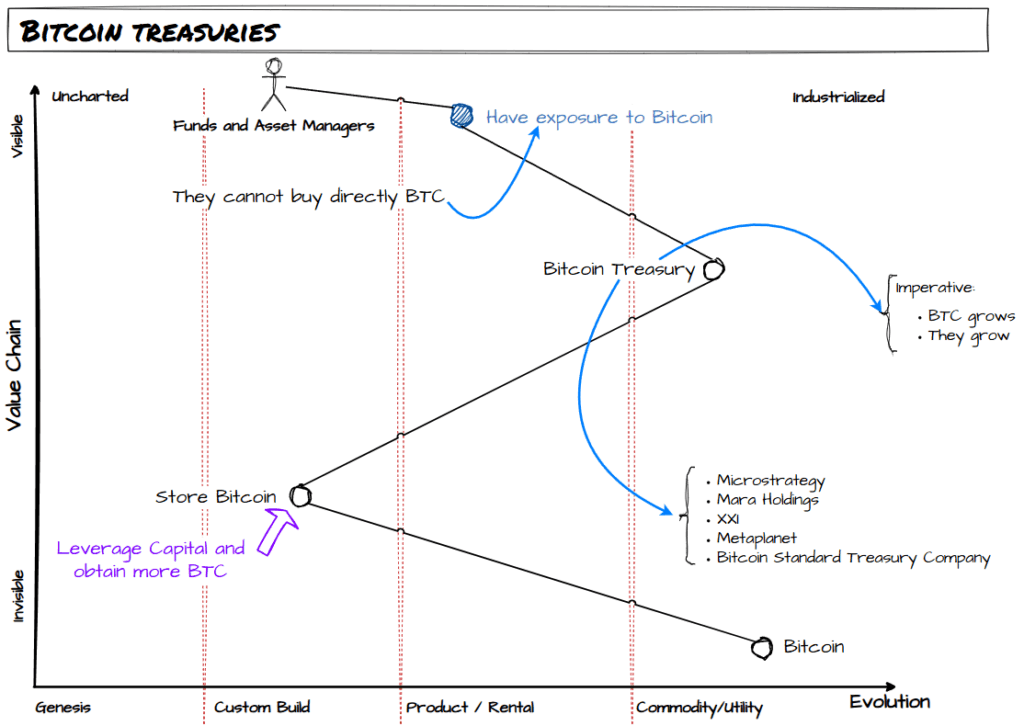
Institutional Investors, specially Funds and Asset Managers, why?
Many large institutions, such as retirement funds, mutual funds, or family offices, face strict regulatory mandates or risk-tolerance rules that prohibit them from directly owning volatile, non-regulated assets like Bitcoin. Investing in the stock or debt (like convertible notes) of a publicly traded treasury company allows them to gain exposure while staying compliant with their internal mandates.
Who are the main players?
| Rank | Company Name | Ticker | Bitcoin (BTC) Held (Approx.) | Core Business |
| 1 | Strategy (formerly MicroStrategy) | MSTR | 640,250 | Business Intelligence/Bitcoin Treasury |
| 2 | MARA Holdings, Inc. (formerly Marathon Digital) | MARA | 53,250 | Bitcoin Mining |
| 3 | XXI (Twenty One Capital) | CEP | 43,514 | Investment/Bitcoin Treasury |
| 4 | Metaplanet Inc. | 3350.T (TSE) | 30,823 | Investment/Bitcoin Treasury (Japan-based) |
| 5 | Bitcoin Standard Treasury Company | CEPO | 30,021 | Investment/Bitcoin Treasury |
The main ways these companies raise capital are:
- Issuance of Debt Securities (Bonds)
- Equity Offerings (Selling Stock)
- Preferred Stock Offerings (The company issues a class of stock that pays a higher, fixed dividend (e.g., 8-10%) and has priority over common stock in dividend payments.
- Bitcoin Mining Operations (For Miners)
- Existing Cash and Company Cash Flow.
For instance, Microstrategy has these type of products. If you want to understand these products better you need to read the whole conditions. I personally find all abusive, but that’s me. I would like to know who the hell is buying Stride.
| Product Name | Ticker | Type of Security | Key Conditions |
| Strife | STRF | Series A Perpetual Strife Preferred Stock | Dividend: 10.00% fixed rate, Cumulative. Paid quarterly in cash (if declared). Missed dividends accumulate and compound at a higher rate. |
| Stride | STRD | Series A Perpetual Stride Preferred Stock | Dividend: 10.00% fixed rate, Non-Cumulative. Paid quarterly in cash (if declared). Missed dividends do not accumulate or accrue. |
| Strich | STRC | Variable Rate Series A Perpetual Stretch Preferred Stock (STRC) | Dividend: Variable rate (e.g., initially 9.00%), Cumulative. Paid monthly. Designed to compete with money market funds with high yield and stability. |
| Strike | STRK | Series A Perpetual Strike Preferred Stock | Dividend: 8.00% fixed rate, Cumulative. Paid quarterly in cash, Class A common stock, or a combination (at MicroStrategy’s election). Convertible: Holders can convert shares into MicroStrategy’s Class A Common Stock (MSTR) at an initial conversion price of $1,000.00 per common share (equivalent to an initial conversion rate of 0.1000 shares of MSTR per preferred share). |
A map summarizing all things read
 WordPress
 Google +
  Facebook