I have refreshed this map, so that I can understand a little bit what’s going on on IONQ.
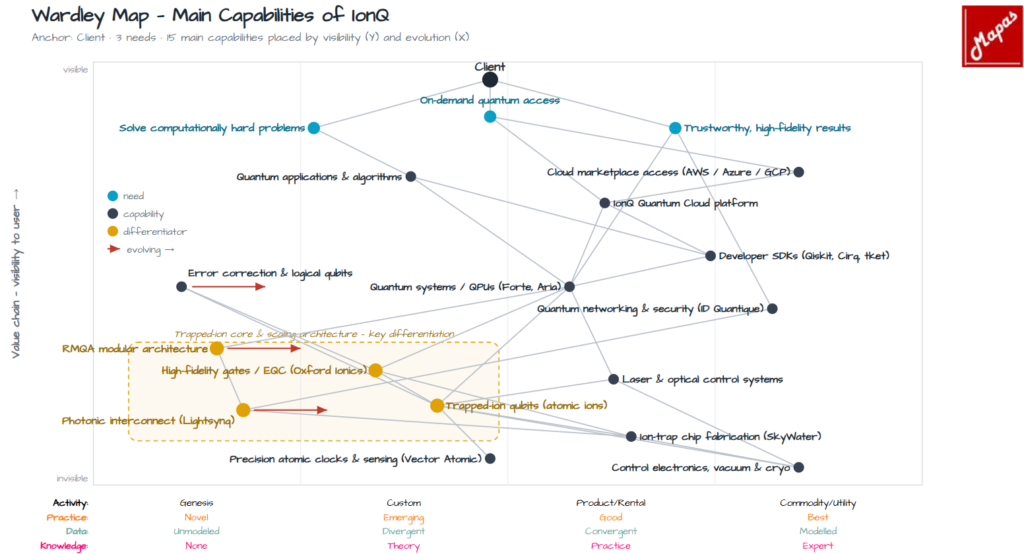
Some comments worth flagging:
- High-fidelity gates / EQC sits at Genesis–Custom because the 99.99% two-qubit fidelity milestone (Oct 2025, via the Oxford Ionics acquisition) is still novel and a source of differentiation, not yet a productised norm.
- RMQA modular architecture and Photonic interconnect (Lightsynq) are in Genesis — both are early-stage scaling bets, hence the movement arrows showing them evolving rightward.
- Cloud marketplace access (AWS/Azure/GCP) and Developer SDKs are pushed toward Commodity because they ride standardised, widely-available platforms (Braket, Azure Quantum, Qiskit/Cirq/tket).
- Ion-trap chip fabrication (SkyWater) and Control electronics/vacuum/cryo are placed low (invisible infrastructure) and toward Product/Commodity, reflecting the pending SkyWater acquisition moving fab in-house.
I only mapped capabilities supported by the sources; the acquisition-linked ones (ID Quantique networking, Lightsynq, Oxford Ionics, Vector Atomic, SkyWater) all trace to 2025–26 IonQ M&A (not before 2025).
Talent acquisition
Since 2024, IonQ has recruited:
- Martin Roetteler from Microsoft Quantum to lead Quantum Applications
- Marco Pistoia from JP Morgan to lead Industry Relations • Rick Muller from IARPA (US Gov intelligent) to lead Quantum Systems
- Scott Millard from Dell to lead Global Go-to-Market as Chief Business Officer.
- Paul Dacier from EMC to serve as Chief Legal Officer
- Dean Acosta from Locked Martin to lead Corp Affairs & Gov Relations
- Shad Reed from Anduril to lead Public Sector Engineering
- Katie Arrington from the U.S. DoD to serve as Chief Information Officer
- Kate Kemp from DocuSign / Airbnb/ Cisco / Intel to serve as Chief People Officer.
ALSO VIA ACQUISTION:
- Mihir Bhaskar from Amazon AWS (founder of Lightsynq) to lead Quantum Networking.
- Chris Ballance and the broader Oxford Ionics team (arguably world’s best quantum physicists)
 WordPress
 Google +
  Facebook