I have been reading about the type of economy that the US secretary of the treasury envisions.
When Bessent was leading Key Square Group, he sent a memo to his clients where he commented the lollapalooza.
The Core Concept
The term “Lollapalooza effect” was originally made famous by Charlie Munger. It describes a situation where multiple independent forces—which might not do much on their own—all point in the exact same direction at the exact same time, creating an explosive, exponential outcome.
Bessent argued that if Trump was re-elected he would intentionally align several massive economic forces simultaneously to trigger a market “melt-up” and rapid business growth. But how?
The Playbook: How to Engineer the Lollapalooza Boom
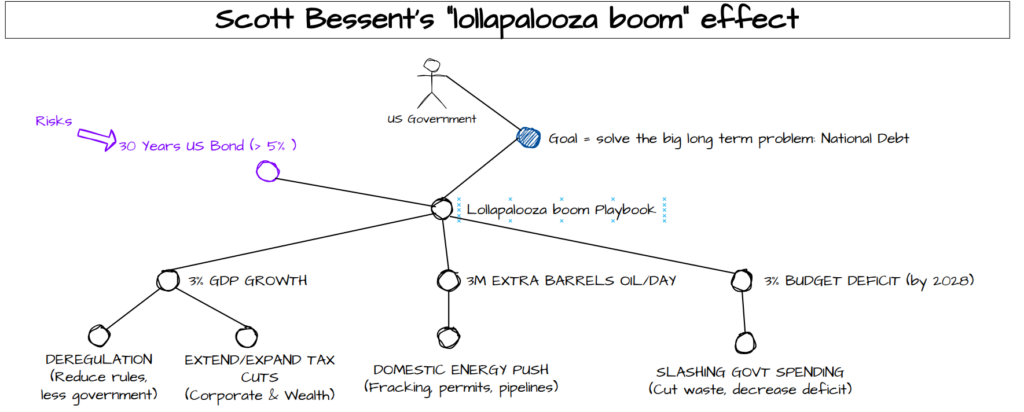
Bessent believes this lollapalooza effect will be driven by specific, aggressive policy shifts designed to unleash the private sector. He has often referred to this strategy as his “3-3-3” policy framework:
- 3% Economic Growth: Achieved through massive deregulation and by extending (or expanding) the corporate and wealth tax cuts from Trump’s first term. Bessent argues that getting the government out of the way will cause private investment and innovation to skyrocket.
- 3 Million More Barrels of Oil: A massive push for domestic energy production to lower energy costs. Cheaper energy acts as an invisible tax cut for consumers and businesses, making everything cheaper to produce and transport.
- 3% Budget Deficit: Reducing the federal budget deficit to 3% of GDP by 2028 by slashing what he views as wasteful government spending.
What are the risks to this approach?
In his thesis, Bessent identifies the bond market as the main threat .
If the government cuts taxes but fails to actually cut spending, the national debt will balloon (remember, it’s expected that the debt reaches $40T this 2026).
If investors (“bond vigilantes”) get spooked by the prospect of inflation or out-of-control debt, they will demand higher returns to buy U.S. debt. This situation would cause a rise in long-term interest rates.
The long term interest of reference is the 30-years US bond, and the accepted value where the balance risk-reward shifts from stock market to bond market is 5%. It’s critical in this thesis to keep the 30-years US bond below 5%.
30-years US bond dictates the interest rates for mortgages, auto loans, and corporate expansions, a spike in rates would instantly choke off the economic boom.
A value chain diagram
Takeaways
Bessent’s “lollapalooza boom” playbook is a combination of:
- Extreme deregulation,
- heavy tax cuts,
- heavy public expenses cut, and
- cheap domestic energy
This recipe tries to create a massive wave of economic euphoria where 30-years US bond needs to be under control, so there is no panic about the national debt (one of the major threats).
So, next time you read the news and hear about some of these concepts, you will understand what is behind these headlines.
All this is linked to this Wardley Map, that you can read about it here.

 WordPress
 Google +
  Facebook