I am curious about why Meta still has not a solution for their AI Glasses for finding lost objects. It’s not an easy solution, so I wanted to analyze it a little bit.
The user and its needs
Three random type of users that came to my:
- People with memory or cognitive challenges, and their caregivers. They have the highest pain, and Meta’s own accessibility work points at keys and phones.
- Existing Ray-Ban Meta and Oakley Meta owners who wear them at home. They already use “Hey Meta” and accept the privacy trade-off, so they are the cheapest to reach.
- Busy multi-person households. Others move your things, so a shared “where did it go” index has the most value. They also have the sharpest privacy concerns.
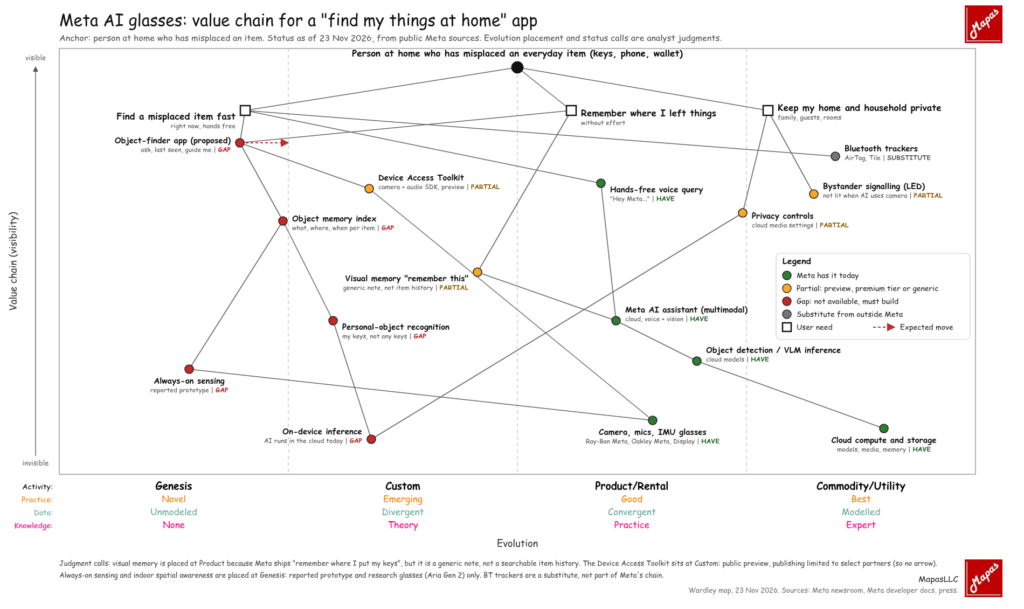
The person at home who has lost an item has three needs: find it fast, remember where things were left, and keep the home private.
Capabilities
- Meta has today:
- Hands-free voice (“Hey Meta”), the cloud multimodal assistant, the camera/mic/IMU glasses and cloud compute.
- Meta also lists “Hey Meta, remember where I put my keys” as a feature (memory feature).
- Partial:
- That memory feature is a generic note, not a searchable history of each item.
- The Device Access Toolkit is in developer preview, and publishing is currently limited to select partners.
- Privacy controls and the capture LED are partial too. On newer models, the LED does not illuminate when a wearer uses camera-based AI features.
- Gaps the app must build:
- An object memory index (what, where, when).
- Recognition of your own objects, so “my keys” rather than any keys; “My wallet” rather than any wallet.
- Always-on sensing, which is only a reported prototype. Reports describe “super-sensing” glasses that continuously record audio and snap photos every few seconds.
- On-device inference. You can’t use any AI features locally on the glasses, according to the Electronic Frontier Foundation (EFF).
- Substitute: Bluetooth trackers (AirTag, Tile) are not part of Meta’s chain, but they meet the same need.
Objections to building it
- Meta may build it natively. Meta already ships the keys feature, and its Aria Gen 2 research glasses showed that participants said the glasses could help them remember where they left items like keys or phone.
- Platform access is limited, because the toolkit is a preview with partner-only publishing.
- In-home capture feeds the “creepy glasses” reputation, and family and guests never consented.
- Home imagery has to go to the cloud, since AI doesn’t run on the device.
- Battery and heat limit continuous capture.
- A cheap tracker is “good enough” and doesn’t need glasses.
- People take glasses off at home, which is where items get lost.
- The need is low-frequency, so willingness to pay is unproven.
- A wrong “last seen” answer destroys trust faster than no answer.
- Recording and biometric laws vary by region.
Risks
The highest-severity ones are:
- Privacy backlash from continuous in-home capture.
- Bystander consent for family, guests and children.
- Platform dependency (preview SDK, partner-only publishing).
- Security of home imagery.
The map
 WordPress
 Google +
 Facebook